ServicesReverse Osmosis
Reverse Osmosis in Camarillo
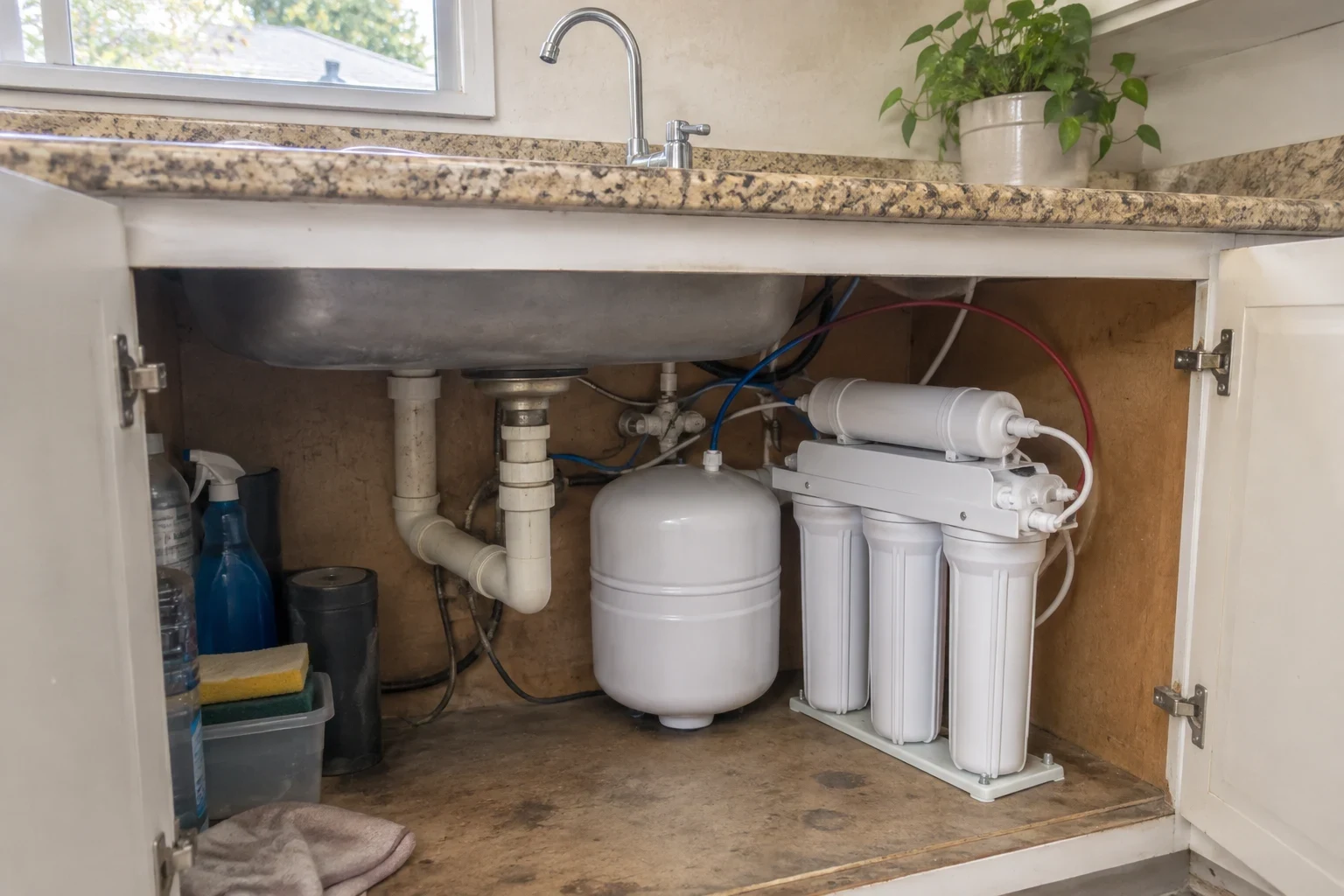
Our reverse osmosis systems mount in the cabinet beneath your kitchen sink and feed a faucet of their own for coffee, soup and drinking. We shut the water off before touching a pipe, use real shutoff fittings, add a drain air gap and check every joint for leaks before we go.
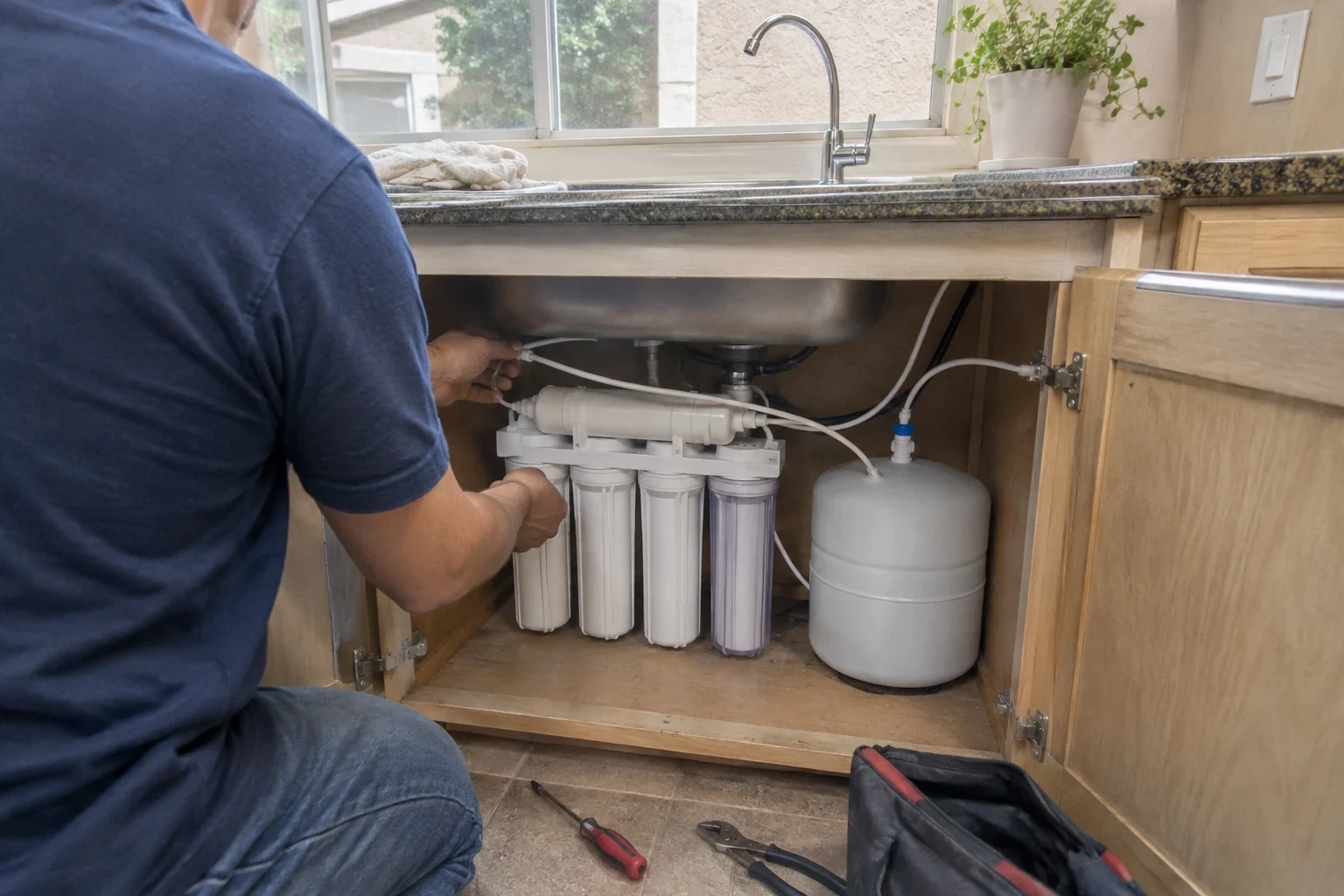
What Reverse Osmosis Does at Your Sink
Inside the unit, your own water pressure pushes tap water against a membrane with openings far smaller than a hair. Dissolved salts, metals and other particles can't squeeze through, so they get rinsed off to the drain. What does make it past the membrane is the water that fills your glass, coffee pot, soup pot and ice tray.
This system treats water at one spot only. The unit lives in the cabinet below your kitchen sink and runs a small faucet of its own. Your shower and washing machine still get regular water. For filtered water at every tap, look at Whole Home Water Filtration or Dual Tank Water Filtration.
With RO, most problems come from a sloppy install, not from the unit itself. A push fitting that is not fully seated can soak the cabinet. A drain line with no air gap can let dirty water creep back toward what you drink. We set it up so neither one happens.
What Comes With the Install
- Multi-stage filter unit
- You get a sediment pre-filter, a carbon stage, the RO membrane and a carbon polishing filter. The carbon catches chlorine early, which protects the membrane and fixes the taste.
- Storage tank or tankless unit
- Most sink cabinets have room for a small pressure tank. A tankless unit takes up less space and makes water as you pour. We measure your cabinet and help you choose.
- Dedicated faucet
- Your filtered water gets its own faucet on the sink deck. If there is a spare sprayer hole we use it. If not, we drill a clean new one.
- Proper supply valve
- We connect to the cold line with a real shutoff tee. We skip self-piercing saddle valves because they are known to drip and give out.
- Drain line with an air gap
- The waste tube joins your sink drain through a backflow gap. Dirty drain water has no path back into the clean side.
- Optional fridge or ice maker line
- We can run tubing over to the refrigerator, so the ice maker and the water dispenser both draw from the RO system.
When an RO Faucet Is Worth It
Cases of bottled water in the garage
If you keep hauling water home from the store, an RO faucet takes over most of that job. Less lifting, less plastic in the bin.
Tap water smells like a pool
A chlorine taste or smell keeps plenty of people from drinking out of the tap. The carbon filters in the system take it out.
White crust on the kettle
That scale in the kettle or coffee maker is left over from dissolved minerals. Water from an RO system leaves much less behind.
Cloudy ice cubes
Cubes turn cloudy when dissolved solids freeze inside them. Running the fridge off RO water usually clears them up.
Older plumbing in the house
Old pipes and fixtures can put metals into your water. RO gives you an added layer of protection for what you drink and cook with.
What Moves the Price
Install is free (we cover the cost). What you pay depends mostly on the system you choose and what it needs to fit your kitchen. We go over each piece on the phone so you know where the money goes.
Tank or tankless
Tankless units cost more up front but take less space and give steady flow. Tank systems are simpler and fit most budgets.
Add-on stages
A remineralization filter adds back a little calcium and magnesium for taste. A UV stage is another option. Each one adds to the unit cost.
Countertop material
Laminate is easy to drill. Granite or quartz needs a special bit and more care, which can affect the parts needed.
Fridge line
Running tubing to the refrigerator depends on the distance and the route. A long run behind cabinets takes more material.
What Happens on Install Day
- 1
Check the cabinet
We look over the space, cold water line, drain and countertop, then show you where the unit, tank and faucet will sit before we begin.
- 2
Water off, cabinet covered
We shut the supply valve, release the pressure and put down towels and a tray so the cabinet floor stays dry.
- 3
Mount and hook up
The unit goes on the cabinet wall. We add the supply tee, the drain saddle with its air gap, the tank and the faucet, cutting each tube square and seating it all the way.
- 4
Flush and check for leaks
Water comes back on slowly while we flush the filters and run the system. We feel each joint and wipe it with a dry paper towel, and nothing is closed up while it's wet.
- 5
Show you the basics
You learn where the shutoff is and how and when to change filters, and we leave a short schedule to tape inside the cabinet door.

Reverse Osmosis Questions
Does reverse osmosis waste water?
It does use some extra. The membrane keeps itself clean by flushing the rejected minerals out with a stream of water, and that stream goes down the drain. Today's units send far less down the drain than the old ones did, and we can steer you toward an efficient model.
Will the RO faucet run slower than my kitchen tap?
Yes, a little. The flow is steady but softer than your main faucet. If you go with a tank, there is water stored and ready, so filling a pot or pitcher does not take long.
Does RO take out the good minerals?
It pulls out most dissolved minerals, the helpful ones along with the rest. For most people, food is where their minerals come from anyway. If you like water with a bit more body, a remineralization stage can be added after the membrane to restore some calcium and magnesium.
When do the filters and membrane get replaced?
The pre-filters usually last 6 to 12 months. The membrane goes a few years before it needs swapping. A busy kitchen wears them out sooner, and a light-use one gets more time out of them. We write the dates down for you so you are not left guessing.
What if a fitting leaks later?
Turn the small valve on the supply tee and the system stops taking water. Then call us and we will come out to look at it. On install day we show you exactly where that valve is, so you are not hunting for it under the sink.
Better Water at Your Kitchen Sink
We put in RO systems across Camarillo and nearby towns such as Oxnard, Ventura and Thousand Oaks. Describe your sink to us and we'll help you choose a system that fits.